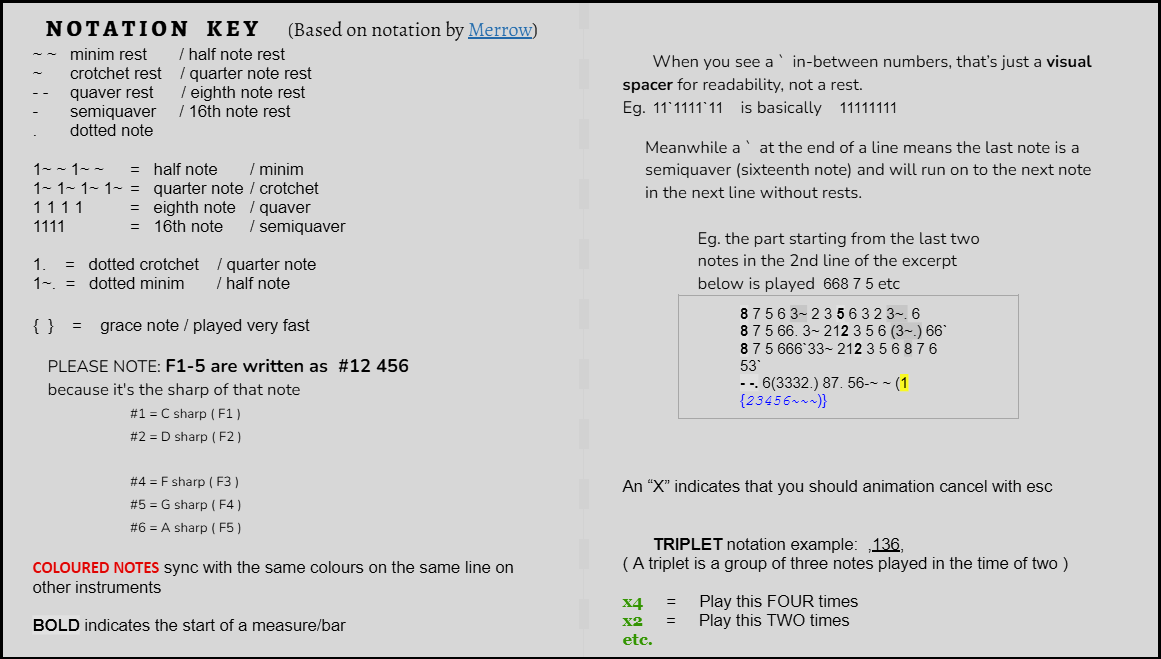
Notation Key
NOTATION KEY (Based on notation by Merrow)
| ~ ~ | minim rest | / half note rest |
| ~ | crotchet rest | / quarter note rest |
| - - | quaver rest | / eighth note rest |
| - | semiquaver | / 16th note rest |
| . | dotted note |
| 1~ ~ 1~ ~ | = | half note | / minim |
| 1~ 1~ 1~ 1~ | = | quarter note | / crotchet |
| 1 1 1 1 | = | eighth note | / quaver |
| 1111 | = | 16th note | / semiquaver |
| 1. | = | dotted crotchet | / quarter note |
| 1~. | = | dotted minim | / half note |
| { } | = | grace note / played very fast |
PLEASE NOTE: F1-5 are written as #12 456
because it's the sharp of that note
#2 = D sharp ( F2 )
#4 = F sharp ( F3 )
#5 = G sharp ( F4 )
#6 = A sharp ( F5 )
COLOURED NOTES sync with the same colours on the same line on other instruments
BOLD indicates the start of a measure/bar
When you see a ` in-between numbers, that’s just a visual spacer for readability, not a rest.
Eg. 11`1111`11 is basically 11111111
Meanwhile a ` at the end of a line means the last note is a semiquaver (sixteenth note) and will run on to the next note in the next line without rests.
Eg. the part starting from the last two notes in the 2nd line of the excerpt below is played 668 7 5 etc
8 7 5 66. 3~ 212 3 5 6 (3~.) 66`
8 7 5 666`33~ 212 3 5 6 8 7 6 53`
- -. 6(3332.) 87. 56-~ ~ (1 {23456~~~)}
An “X” indicates that you should animation cancel with esc
TRIPLET notation example: ,136,
( A triplet is a group of three notes played in the time of two )
| x4 | = | Play this FOUR times |
| x2 | = | Play this TWO times |
| etc. |
Show the original image of this key